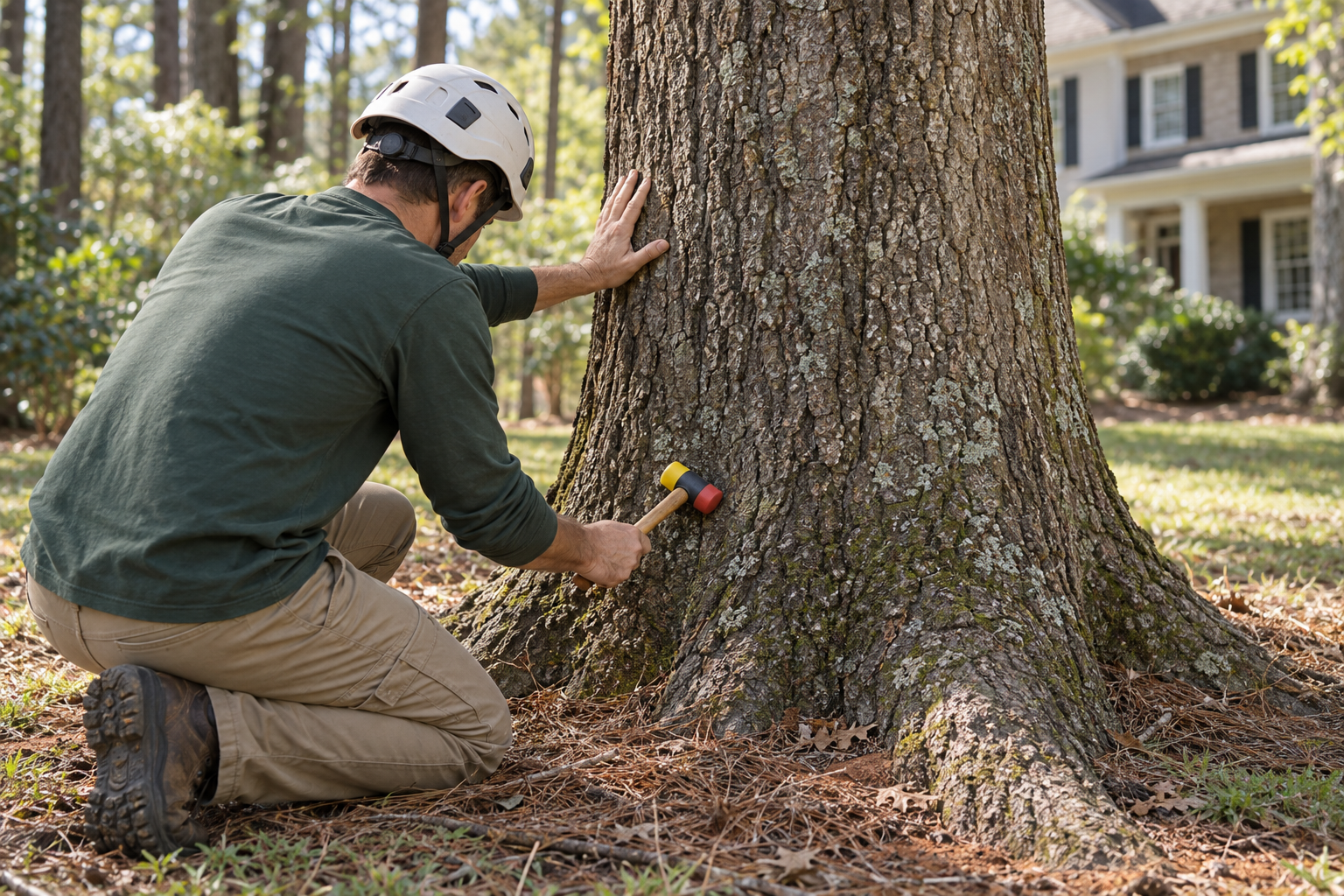
arborist inspecting oak trunk Alpharetta

Arborist visits

An Arborist's Look at Your Alpharetta Trees

Not sure about a tree? We look it over from the soil to the crown, tell you plainly whether it is safe to keep, and weigh removal last.

We answer or call back the same working day. (470) 348-6983

What we check

Arborist Tree Inspections in Alpharetta

An arborist inspection checks a tree's canopy, trunk, roots and soil to judge its health and the risk it poses to people and property in Alpharetta.

No one part tells the whole story. Thin leaves up top often trace back to damaged roots below, so the answer comes from reading the tree from the ground up, in this order:

  1. Ground level

    The soil

    What the tree stands in. Digging, grading or new paving inside the "critical root zone", the root area out to the drip line, damages the roots the tree lives on.

  2. The base

    The roots

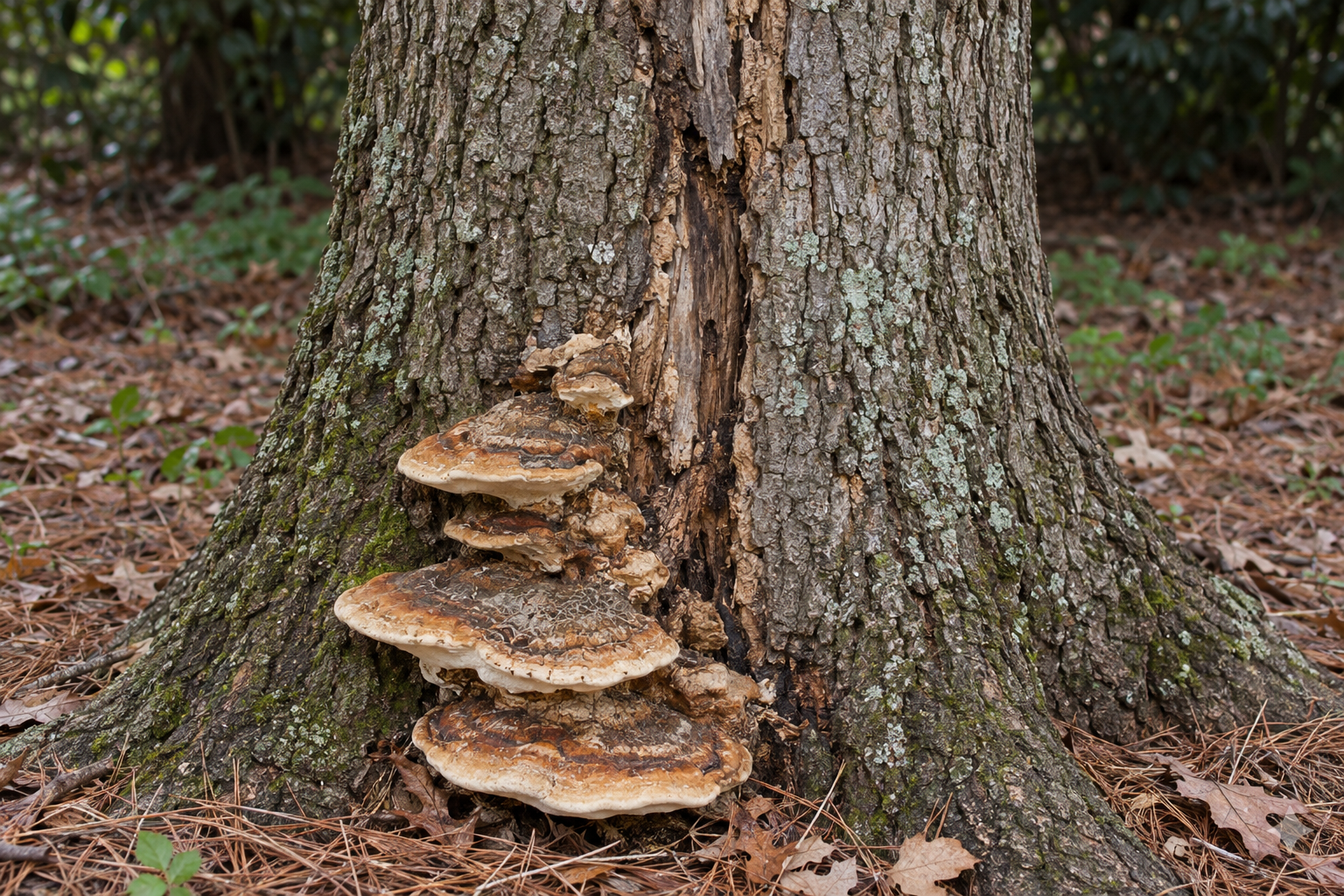
    The "root flare", where the trunk widens into its roots, and the ground around it: soil heaving on one side, cut or rotted roots, fungus growing at the base.

  3. The stem

    The trunk

    Cracks, seams, hollows and a lean, and the joint where "co-dominant stems", a double trunk, meet. That joint is a common place for a tree to split.

  4. The crown

    The canopy

    Dead and hanging limbs, thin or off-color leaves, and dead wood that could come down in the next storm, including decay that only shows from inside the crown.

Bracket fungus growing from the base of a hardwood trunk beside a long bark seam

Judging the risk

Tree Risk Assessment and Tree Health

A risk assessment weighs a tree's defects, what it stands to strike if it fails and how likely that failure is, and climbers check the canopy for decay unseen from the ground.

A formal assessment follows the Tree Risk Assessment Qualification standard, "TRAQ", set by the International Society of Arboriculture. It comes down to these questions:

The defect
What is wrong with the tree, and how far it has gone.
The target
The roof, the drive, the fence or the people it would hit.
The odds
How likely the tree or the limb is to fail, and how soon.

How a visit goes

From your call to a straight answer

A visit runs the same way every time, from the phone call to the moment you know what the tree needs. These are the steps, in order.

Call for an Estimate
  1. You call

    Tell us which tree and what you have noticed: a lean, a crack, dead limbs, fungus at the base. We answer the phone or call back the same working day.

  2. We set the day

    We agree on a day to come out, and we show up when we say we will.

  3. The look

    We read the tree from the soil and roots up through the trunk to the canopy. Where decay may hide high in the crown, a climber checks it from inside, because some of it cannot be seen from the ground.

  4. The answer

    You hear what we found, whether the tree can be kept, and what would keep it. If it needs work, we quote the whole job before we start, with no surprise charges after.

What it costs

How an Arborist Visit Is Priced

An arborist visit is priced on how many trees we look at and whether you need a written assessment.

The size of the property and how detailed the inspection has to be move it too. We tell you what your visit costs on the phone before we come, and if the tree needs work, that job is quoted in full before we start.

Typical arborist consultation

$75 to $250

Around metro Atlanta, an arborist consultation typically runs $75 to $250. Your exact price comes from the call.

(470) 348-6983

Keep it or take it down

Cabling, Bracing and Other Alternatives to Removal

Pruning, cabling and bracing can save a healthy tree with a weak union, so removal is weighed last.

Good crews treat removal as a last resort and consider pruning, cabling and plant health care first. The inspection shows which of these fits your tree, and we tell you plainly before any work is quoted.

This is the order a tree gets weighed in, from the lightest fix to the last resort:

  1. Pruning

    "Crown cleaning" takes out dead, diseased and broken branches, and "crown reduction" makes a tree smaller while keeping its natural form. Neither is "topping", which cuts limbs back to stubs and harms the tree.

  2. Cabling and bracing

    Cables and rods support weak limbs or a split union, such as a double trunk, so a healthy tree can stay standing.

  3. Restoring after a storm

    A storm-damaged tree can sometimes be restored instead of taken down, depending on how much canopy is left and whether the trunk and roots are sound.

  4. Removal

    For the tree that is dead, dying or diseased, the "3-D" tree, or whose structure is too far gone to hold. Then we take it down safely and clean up when the work is done.

Neighbors on Google

What our customers say

These are our Google reviews, word for word as the people who wrote them put it.

Competitive price and they did a great job. I would definitely use them again.
Tracy Turner Google review
This group is fantastic 98 degrees outside they did not stop these are heros
Vickie Lewis Google review
These guys came highly recommended from friends and family. Alejandro Came and gave me a competitive quote on the same day, for a giant white oak that others said was too big. Showed up on time on the day we agreed on and did an amazing job. You can’t even tell they were here aside from the massive tree that’s gone. 10/10 would recommend to anyone. Fantastic crew.
Dan Jones Google review
  • Free, no-obligation estimates
  • We show up when we say we will
  • The whole job quoted before we start

The credential

What an ISA Certified Arborist Is

An ISA Certified Arborist has passed the International Society of Arboriculture's written exam in tree biology, diagnosis and risk.

That testing is what separates an arborist from a general tree trimmer: the training is in why a tree is failing, not only in how to cut it. The Georgia Forestry Commission advises having tree care done by a certified arborist trained in tree diagnosis, and TreesAreGood.org: Why Hire an Arborist lays out what the credential covers and when removal is warranted.

When the answer is pruning rather than removal, our trimming page covers how that work goes.

tree trimming in Alpharetta

Arborist Visits Across Our Service Area

Arborist visits reach every town in the area we serve, not only Alpharetta.

That takes in Johns Creek, Roswell, Milton and Peachtree Corners, and we take calls from Berkeley Lake, Mountain Park, Duluth, Dunwoody, Norcross, Sandy Springs, Doraville and Suwanee as well. A tree outside that footprint is a question for the call.

tree removal service area

Questions we hear

Arborist questions, answered

What does an arborist do?

An arborist judges a tree's health and the risk it poses by looking at its canopy, trunk, roots and soil, then says what care it needs. A certified arborist is trained and tested in tree biology, diagnosis and risk, which sets the work apart from general trimming.

How long is schooling to be an arborist?

The credential homeowners hear most about is ISA certification, and it requires passing a written exam in tree biology, diagnosis and risk. The International Society of Arboriculture sets what that exam covers and what it takes to sit it.

Is an arborist a hard job?

It is physical work, and parts of it are dangerous. Climbers go up into the canopy to check for decay that cannot be seen from the ground, and storm work around broken and hung-up trees is hazardous.

Worried about a tree?

Have us look before you decide anything

One call gets the tree looked at and a plain answer on whether it can stay. We answer the phone or call back the same working day.

Open Monday to Saturday. Calls outside our hours go to voicemail and we return them the next working morning.

On the day we agree

We show up when we say we will, and we clean up when the work is done.

No surprise charges

We quote the whole job before we start, with no surprise charges after.

Call (470) 348-6983